Pool fencing rules in Auckland
Residential pools capable of holding 400 mm or more require a barrier restricting unsupervised access by children under five; Building Code F9 and inspections apply.
Last reviewed: 2026-08-12. General information only. A pool-fence calculator or product page cannot certify Building Code compliance.
MBIE states that residential pools capable of holding 400 mm or more of water require a physical barrier restricting unsupervised access by children under five. The rule covers permanent, temporary and portable pools. The barrier must be designed and maintained as a whole.
Building Code F9
Clause F9 sets the performance requirement. F9/AS1 provides an acceptable solution for pool barriers such as fences and building walls. F9/AS2 addresses qualifying covers for small heated pools. Use the current documents rather than a contractor blog summary.
Gate and immediate pool area
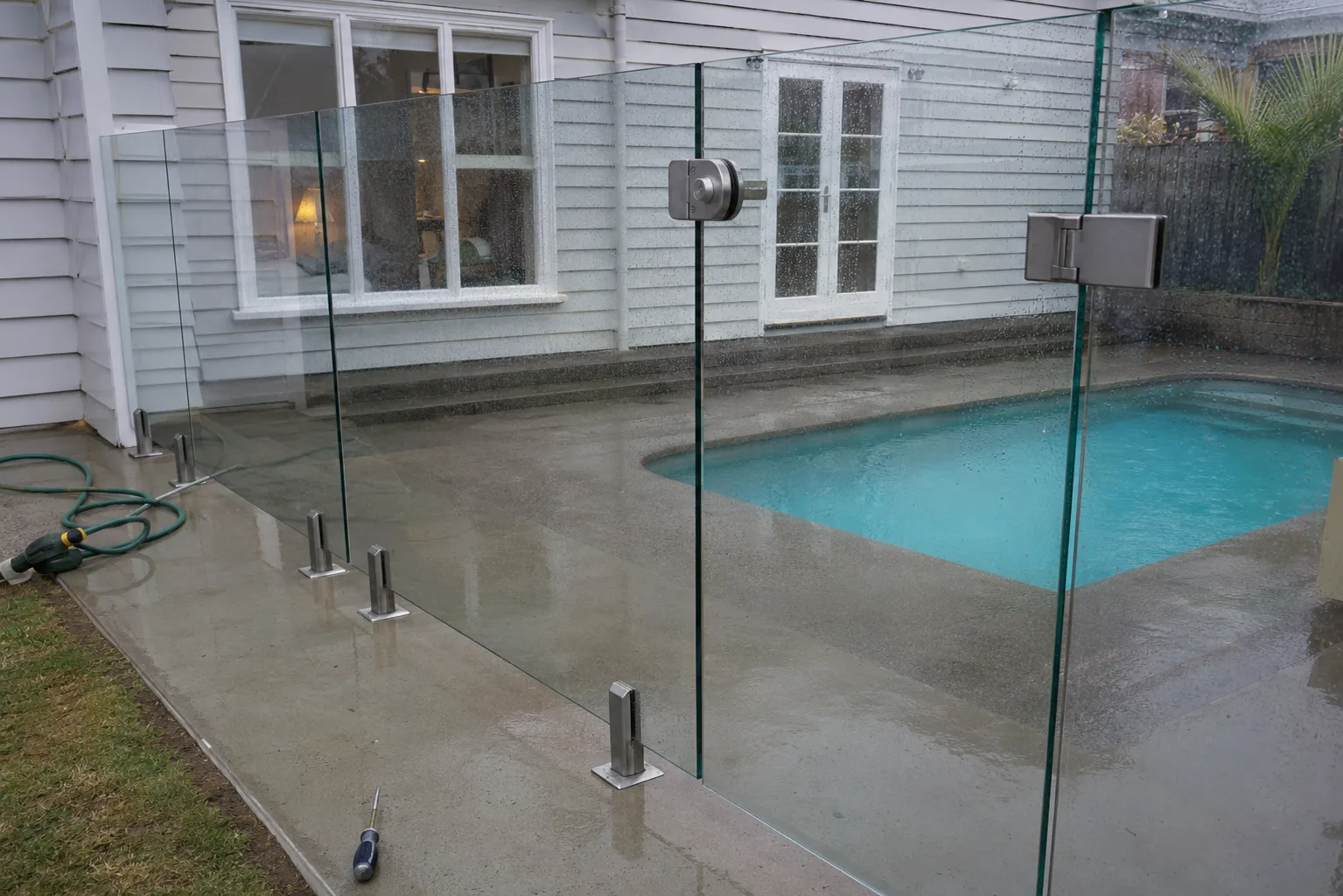
MBIE owner guidance says gates need to open away from the pool area and be self-closing and self-latching. Test operation from varied open positions and maintain alignment. Furniture, barbeques, storage, play equipment and climbable landscaping can affect the immediate pool area and barrier performance.
Consent and recurring inspection
Pool barriers are outside the ordinary fence exemption and require building consent. The Building Act requires residential pools to be inspected every three years by the territorial authority or an independently qualified pool inspector. A compliant safety cover for a qualifying small heated pool follows a different route; check every F9/AS2 condition.
Owner lifecycle checklist
- Design the complete barrier and immediate pool area.
- Obtain consent before construction/filling as required.
- Retain approved plans, Code Compliance Certificate and product documents.
- Keep gates, doors, openings and surroundings compliant between inspections.
- Reassess after landscaping, decking, building-door or hardware changes.
Compare glass and pool-fencing systems, then model panels and gates in the pool fence calculator. Compliance remains a separate professional/council assessment.
Authoritative sources
Auckland owners need a consent-to-operation chain
Start with a compliant barrier design and building-consent pathway, install the approved system, complete the required inspection/documentation, then maintain it in operation. Residential pools are inspected every three years by Auckland Council or an independently qualified pool inspector. Passing once does not protect a gate that later stops self-closing.
Common alteration risks
- A deck, planter or stored object changes climbability outside the barrier.
- A gate drops and no longer self-closes from every position.
- Landscaping changes ground clearance below a panel.
- A door, wall or window used as part of the barrier is altered.
- A replacement latch or hinge changes compliant operation.
What a pool-fence quote should allocate
Identify who prepares consent information, verifies the substrate, supplies product documentation, sets the gate and attends any inspection defect. Record exclusions for paving, drainage, waterproof membranes and unknown reinforcement. The lowest panel rate is not necessarily the lowest compliant completed project.
For the national baseline and gate checks see pool fence requirements. Compare materials in glass versus aluminium and plan component costs on the Auckland pool-fence cost page.
Primary references: MBIE pool safety and F9 documents; Auckland Council pool barrier information.