Glass pool fencing vs Aluminium pool fencing
Glass preserves views at higher cost and cleaning effort; aluminium is visually more present but often easier to budget and maintain.
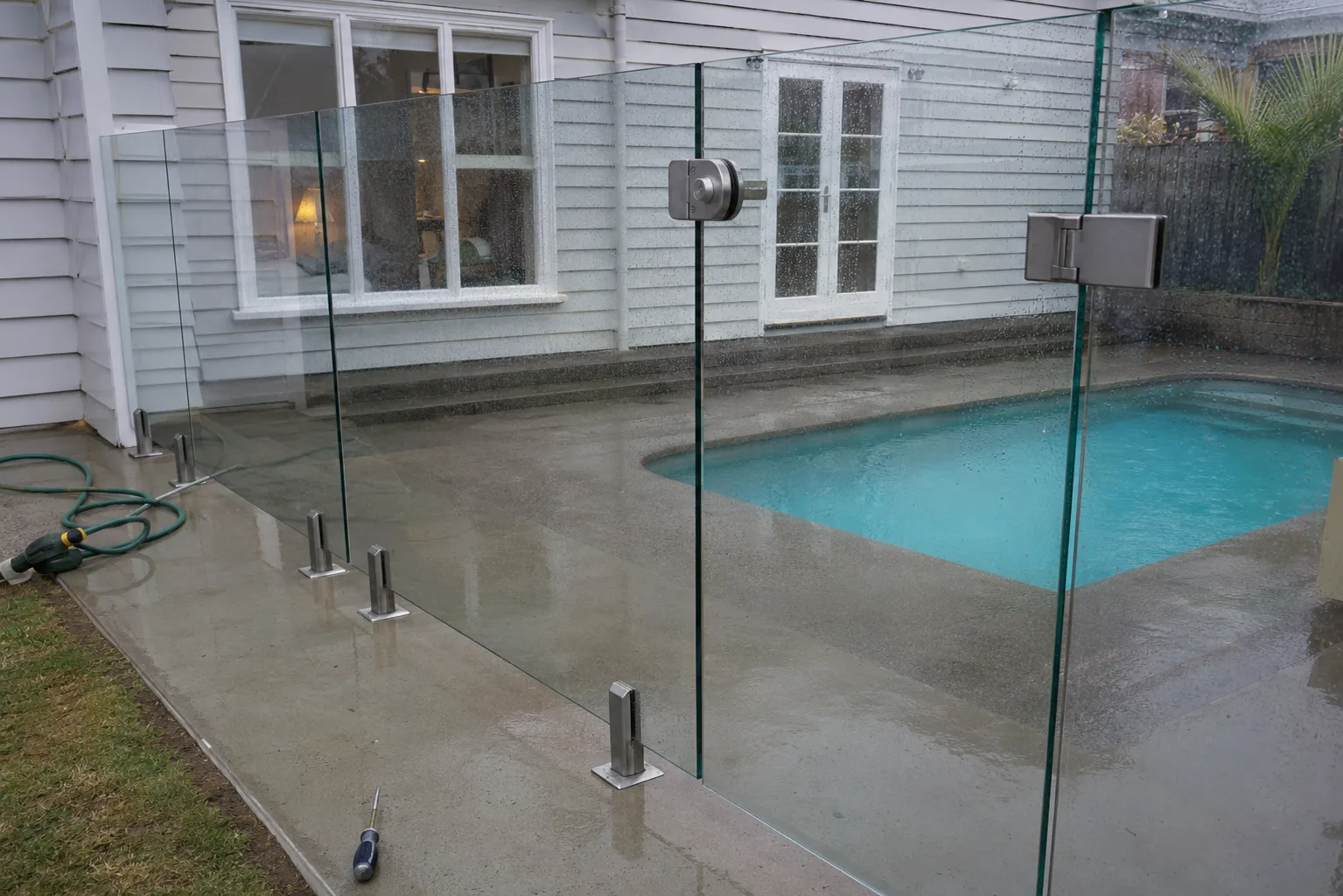
Last reviewed: 2026-08-12. Choose frameless glass where an uninterrupted view is worth the higher material, substrate and cleaning commitment. Choose aluminium where lower planning cost, visual permeability and simpler panel replacement matter more. A mixed layout is often the most rational Auckland answer.
Safety requirements do not change with appearance
Both systems must form part of a complete residential pool barrier that complies with Building Code F9 and the consented design. The barrier layout, immediate pool area, climbable objects, ground gaps and gate behaviour matter together. A compliant-looking panel does not make an incorrectly placed or poorly operating barrier compliant.
MBIE guidance states that barriers must restrict unsupervised access by children under five. F9/AS1 covers pool barriers such as fences and building walls, while gates are required to open away from the pool and be self-closing and self-latching under the acceptable solution. Confirm the current design with Auckland Council rather than relying on a product advertisement.
| Factor | Frameless glass | Aluminium pool panels |
|---|---|---|
| Planning range | $350–$650/m | $180–$340/m |
| View | Least visual interruption through clean panels | Regular vertical rails remain visible |
| Cleaning | Salt, water spots and hand marks show | Wash coating and inspect hardware; marks are less view-critical |
| Substrate | Spigot/channel fixings can demand engineered support | Posts need sound footings but often suit conventional panel layouts |
| Slope | Custom panel geometry and stepped glass can be complex | Raked or stepped systems may be available |
| Repair | Damaged toughened panel is replaced as a panel | Panel or rail replacement depends on the proprietary system |
| Wind | Solid screen; loads transfer to glass and fixings | Open rails allow air through |
The substrate can decide before the material does
Frameless glass transfers load through spigots or a channel into concrete, timber framing or another designed substrate. Existing paving that looks substantial may not have the thickness, reinforcement, edge distance or condition required. A channel system has different waterproofing and drainage considerations from individual spigots.
Aluminium panels usually transfer loads through posts and footings. That can make them easier to place through planted areas or on a boundary without continuous concrete, although ground conditions and post design still matter. Ask the installer to state the fixing substrate and any engineering or opening-up allowance in the quotation.
Preserve the important view corridor
Glass is most valuable where people need a clear line from a living room, deck or outdoor seating area to the water. It is less valuable behind planting, along a service boundary or where glare and reflections already interrupt the view. Mark the actual sightlines on the plan before specifying glass around the entire perimeter.
Aluminium’s vertical rails are visible but visually predictable. Dark rails can recede against landscaping, and the openness can reduce the feeling of a solid wind screen. The design must still avoid climbable configurations and meet the consented barrier details.
Cleaning and coastal Auckland
Glass does not corrode, but it displays salt film, sprinkler residue and fingerprints. Coastal exposure or a busy family pool may require frequent washing to retain the visual reason for buying it. Hardware and fixings remain exposed metal components and must be selected and maintained for the environment.
Powder-coated aluminium also needs cleaning, particularly near the coast. Coating warranty guidance distinguishes marine environments and links suitable product selection with pretreatment, application and care. Ask for the coating specification, hardware material and required wash frequency; “aluminium does not rust” is not a complete coastal maintenance plan.
Gates drive usability
A pool gate is the part of the barrier people touch every day. Compare hinge and latch quality, closing from different open positions, alignment tolerance, access for adjustment and replacement parts. Glass gates preserve the view but add weight and specialised hardware. Aluminium gates are lighter and visually match rail panels. In both cases the installed gate—not the catalogue component—must meet the required self-closing and self-latching performance.
Three layout decisions
Compact pool beside indoor living
Use glass on the principal view edge. Confirm the slab or deck structure before finalising panel lengths and hardware. Aluminium may still be used on the less visible side.
Long garden perimeter on ordinary ground
Use aluminium for most of the run. It can reduce initial cost and foundation complexity while preserving visibility through the barrier.
Exposed coastal deck
Compare the complete systems. Glass is solid to wind and depends on substrate/fixings; aluminium is open but relies on coating and hardware care. Obtain site-specific design advice rather than choosing from appearance alone.
Illustrative mixed-system budget
Illustrative planning example: a 15 m barrier uses 5.5 m of glass across the living-room view and 9.5 m of aluminium around the garden. At the structured midpoints, the panel allowance is 5.5 × $485 plus 9.5 × $245, or $4,995 before the compliant gate, substrate work, consent/documentation and site-specific extras. It is a planning model, not a real project or quote.
Decision
- Choose glass for the view-critical portion where the substrate is suitable and regular cleaning is acceptable.
- Choose aluminium for longer secondary runs, gardens, slopes and projects prioritising lower initial cost.
- Choose a mixed barrier when only part of the pool needs a transparent screen.
Read the material details on Glass Pool Fencing Auckland and Pool Fencing Auckland. Check the legal pathway at Pool Fencing Regulations, model segments in the pool fence calculator, then submit one complete barrier plan for quotation.
Sources
Price records: glass pool fencing and aluminium pool fencing, checked 12 August 2026. Compliance: MBIE F9 pool safety and pool owner guidance.